Google Search

Google
 
Showing posts with label Migrating to Australia. Show all posts

Saturday, December 8, 2012

Expression of Interest: EOI

What is EOI:

From 1 July 2012, all intending migrants interested in the points based skilled migration or business investment and innovation visa programs will be required to submit an EOI and receive an invitation in order to lodge a visa application.

An EOI is not a visa application, it is an indication that you would like to be considered for a skilled visa.

You will be asked to provide a range of information in your EOI depending on the visa(s) you want to be considered for, such as:
  • basic personal information
  • nominated occupation
  • work experience
  • study and education
  • level of English skills
  • details of a Skills Assessment, related to your nominated occupation
  • business and investment experience.
For more details on what questions and information you will need to supply in your EOI, you should refer to the webpage for the visa(s) you are interested in. 

Points Test
For the points based skilled migration and business innovation and investment visa programs , you will be ranked according to the appropriate points test. You will be able to submit an EOI even if you do not meet the pass mark; however, you will not be invited to apply for a visa. For information about how to calculate the points test, you should refer to the points test tab on the webpage for the visa you are interested in.

It is important to remember that meeting the points test pass mark does not guarantee you an invitation to apply for a visa.

If you select the subclass 190 or 489 visa(s) you will receive the appropriate points for nomination or sponsorship. For example if you select the 190 visa subclass you will receive 5 points which will be added to your points score. Your points score based on your claims in your EOI will then be displayed before you submit your EOI.

Nominated Occupation
If you are submitting an EOI for a visa that requires you to list a nominated occupation you should establish if your occupation is a skill that Australia needs. You can do this by checking the Skilled Occupation Lists. You must provide details of a Skills Assessment relating to your nominated occupation in your EOI.

What you need to do before submitting your EOI

While you don’t need to submit documents supporting your claims when you submit your EOI, you must have a range of information prepared.
For example, for an independent skilled visa you must have:

  • completed a skills assessment and/or a job ready program
  • taken an English-language test to prove you meet the English language requirement.
For details on what information you need to provide on your EOI, you should refer to the webpages for the visa(s) you are expressing interest in. 

Submitting an EOI

If you have researched your visa options and prepared the information required, you are ready to submit an EOI. All EOIs must be completed online using SkillSelect. You start your EOI by selecting the “submit an EOI” button on this website.

There is no fee to submit an EOI in SkillSelect.When you complete your EOI the system will give you a points score and results based on your claims.

Your result and points score, along with your time and date of effect becomes your ranking for some visas.  The time and date of effect of your EOI, is the date and time you submitted your EOI or the latest date and time you updated your EOI causing your eligibility or points score to change. Rankings are processed automatically by SkillSelect with no involvement of the department’s staff.

To submit a complete EOI you must meet all the threshold criteria for the relevant visa subclass yo uexpress interest in. If you do not meet the threshold criteria, you will have to deselect the visa before you can submit a complete EOI.

Once you have completed your EOI, it is stored in SkillSelect and is valid for two years.
If you have not completed your EOI it will be stored for two years, but you will not be eligible to receive an invitation.

After submitting an EOI

After you submit your completed EOI, you will receive notification from SkillSelect.

You can access your EOI and update your information at any time. You may wish to do this if you have gained new work experience, gained a higher qualification, improved your English language ability and/or changed your family composition. If you provide updated information which changes your points score or your ability to make a complete EOI, SkillSelect will update your ranking and ability to be considered for an invitation automatically.

It is your responsibility to access your EOI and update your details if your circumstances change. You will not be able to update your EOI after you have received an invitation. Your invitation to lodge a visa application is based only on the information presented in your EOI.

Your invitation to lodge a visa application is based on only on the information presented in your EOI. If you lodge a visa application and your points score is less than claimed in your EOI and invitation letter, your visa will be refused even if you are able to pass the points test or meet other threshold criteria. You will not receive a refund of any visa application charge if your visa application is refused.

If you receive an invitation and your points have decreased or your personal information is not accurate, you do not have to proceed to make an application. You should correct the information in your EOI and wait to receive another invitation.


Suspending, withdrawing or removing an EOI

Suspending an EOI

If you are unable to access your EOI for a length of time, then you can choose to suspend your EOI. While this will not extend the validity of your EOI it will stop you receiving invitations or contacts that you cannot act on, and will avoid your EOI being removed while you are, for example, on holiday and receive two invitations during that time.

If you receive an invitation, your EOI will be suspended automatically so your EOI cannot be considered for any subsequent invitation rounds or be available to employers to search for and contact you. Your EOI will remain suspended until such a time that you lodge a visa application and that application is finally determined or 60 days ceases and you do not lodge a valid visa application.  During this time you can view your EOI and your correspondence, but cannot update your answers on your EOI or select different visa types. 

Withdrawing an EOI
You can withdraw your EOI at any time by accessing your SkillSelect account and selecting the option “Withdraw EOI”. If you withdraw your EOI it will be permanently removed from SkillSelect. 

Removing an EOI
If you receive two invitations and you do not lodge a visa application in response to either of these invitations, your EOI will be removed from SkillSelect.

Your EOI will be removed automatically if it expires. Submitted EOIs expire after two years.  EOIs that are begun, but are never submitted as a complete EOI will also be removed automatically two years after they are commenced.

If you do not comply with the terms and conditions of SkillSelect, your EOI can be removed by the department at any time. You will be asked to read and agree to the terms and conditions when you register for a SkillSelect account. 

If you have a decision on a substantive visa application
If you are granted, refused or withdraw a permanent visa or a 489 or 188 provisional visa application, your EOI will be removed from SkillSelect.

If you are granted, refused or withdraw a temporary visa application, your EOI will remain in SkillSelect for future selection unless it is withdrawn, expires, or is removed.

Invitation and selection process 

Depending on what type of visa(s) you want to be considered for, you may receive an invitation to lodge a visa application, or an Australian employer may contact you to discuss a job opportunity. 

Occupation ceilings
An occupation ceiling may be applied to invitations issued under the points based skilled migration program. This means there will be a limit on how many EOIs are selected for skilled migration from an occupation group. This ensures that the skilled migration program is not dominated by a small number of occupations.

When this limit is reached, no further invitations for that particular occupation group will be issued for that program year. Invitations would then be issued to other EOIs who have nominated available occupations even if they are lower ranking. For the state and territory nominated visas, a state or territory will not be able to nominate you if your nominated occupation has reached its occupation ceiling.

You can view the occupation ceilings on the Reports page. 

Independent and family sponsored visas

Invitations will be issued automatically to people with the highest ranking EOIs, subject to occupation ceilings and to those whose points score exceed the current pass mark.

The points test pass mark is the minimum number of points required to receive an invitation. Not all EOIs that meet the points test pass mark will receive an invitation.

The department’s staff will not choose who will receive an invitation. Invitations will be issued regularly, such as every month. 

State and territory nominated visas

State or territory governments can select skilled workers who they want to nominate. State and territory governments may do their own assessment of people before they nominate them. If you are nominated by a state or territory and you have indicated that you meet the points test pass mark, you will then receive an invitation, subject to occupation ceilings.

When you submit an EOI for one of these visas, you will be asked to choose which state or territory you wish to live and work in. You can select one state or territory, or any state or territory. You will also be asked to indicate if you are prepared to live and work in a non-metropolitan area. If you choose only one state or territory then that state or territory government will be able to view your EOI. If you select any state or territory, then all state or territory governments will be able to view your EOI.

For more information about what the state or territory government's assessment criteria, refer to the state or territory government websites:
Business innovation and investment visas
 State or territory governments will locate and select skilled business people that they want to nominate. State and territory governments may assess people before they nominate them. If you are nominated by a state or territory and you have indicated that you meet the points test, you will automatically receive an invitation.

On a limited basis, nominating state or territory governments may award additional points towards the innovation points test where they have determined that your proposed business is of exceptional economic benefit to that state or territory.

When you submit an EOI for one of these visas, you will be asked to select which state or territory you wish to live and work in. You can choose one state or territory, or any state or territory. If you select only one state or territory, then that state or territory will be able to view your EOI. If you select any state or territory, then all state or territory governments will be able to view your EOI.

For more information about what the state or territory governments will assess you on before nominating you, refer to the state or territory government websites:
Employer sponsored visas 
Employers can search for and contact skilled workers that they want to discuss job opportunities with. If you are contacted by an employer in SkillSelect, you can choose to respond to them to discuss employment and visa opportunities. You will not receive an invitation to apply for an employer sponsored visa.
When you submit an EOI for one of these visas, you will be asked which state or territory you are interested in living and working. You will also be asked to indicate if you are prepared to live and work in a non-metropolitan area. You will be able to select one or more state or territories, or any state or territory. Employers will be able to view your EOI and will be able to narrow their searches to specifically focus on skilled workers in their area. SkillSelect protects your personal information such as your name, date of birth and other characteristics that could personally identify you. This information will not be made available to employers.

If you have already received sponsorship from an employer, you do not need to submit an EOI in SkillSelect. 

If you receive an invitation

If you are invited to apply for a visa, you will receive an invitation from SkillSelect. You will then have 60 days to make a valid visa application online, before the invitation expires. Applications received outside this timeframe will be invalid.

The invitation will contain instructions on how you can lodge your visa application.
As the online visa application system uses information from your EOI, you do not need to re-enter information you already provided on your EOI.

You must provide evidence of your claims with your visa application. Health and character will be assessed and requested during the visa application stage.


Be aware: If you do not make a valid visa application after receiving two invitations, your EOI will be removed from SkillSelect.

If you are not invited or selected

More people want to migrate to Australia than there are places available. This means not everyone who submits an EOI will receive an invitation to apply for a visa.

Your EOI will stay in SkillSelect for two years from the date you submit it. At any time during the validity of your EOI, you may update your details to reflect any additional qualifications or experience you may have obtained. This may increase your likelihood of being invited or an employer contacting you.

You may receive notifications from SkillSelect notifying you of visa programs changes, that your EOI is expiring, or other information that you may find useful. You will not be notified of the progress of your EOI or be able to obtain updates on the likelihood of receiving an invitation.

After each invitation round for the points based skilled migration visas, the department will publish on the Reports page the lowest scoring points test mark that allowed an EOI to be invited for each relevant subclass. This will give you an indication of your potential for receiving an invitation in future rounds.

An EOI is not a visa application. You cannot access merits review by the Migration Review Tribunal (MRT) if you do not receive an invitation to apply. If you want to express concerns to the department about the invitation process, you can provide feedback online - Global Feedback Unit.


Visa programs in SkillSelect

From 1 July 2012, if you are interested in the following visas, you will need to submit an EOI and receive an invitation before you can apply for a visa:
You can also express interest in the following visa programs on your EOI to be contacted by an employer.
You can express interest in a range of skilled migration visas in one EOI.

Wednesday, April 8, 2009

Changes to Australian Migration Program 2009

In December 2008, the Minister for Immigration and Citizenship, Senator Chris Evans, announced a range of changes in response to the global economic crisis to ensure the 2008-09 skilled migration program was better targeted and more responsive to industry needs. These changes came into effect on 1 January 2009.

The measures were introduced to ensure that the skilled stream of the migration program is driven by the needs of industry and targets skills in critical need across a number of sectors, particularly those skills in shortage and which contribute to the health of the economy.

These changes included priority processing with preference to:
  • employer-sponsored permanent migration applications, where skilled migrants are sponsored to go into jobs unable to be filled locally.
  • applicants nominated by state and territory governments, who were also given greater scope to meet critical skill shortages in their jurisdiction; and
  • applicants who had nominated an occupation identified as in critical shortage.
Since then, the global economic situation has continued to deteriorate, and this has significantly weakened Australia’s economic situation, including an increase in unemployment. The migration program is one of the tools the Government can use to assist industry with skills shortages, and, as such, is continually reviewed and assessed for its relevance and outcomes in light of the economic and social needs of Australia. The program is modified as these needs change. The Minister has announced additional measures to further assist in the management of the economy through targeting occupations in critical shortage. These include measures to manage the range of skills and number of people entering Australia with work rights.

This will be achieved through managing the migration program down to a lower level than originally planned, and tighter targeting of program outcomes through the removal of certain trade occupations from the CSL. The new ceiling for the 2008-09 skills stream of the migration program is 115 000 places.

This combination of measures is a balanced response to the changes in global economic circumstances and the corresponding effects in Australia. These changes in strategy in no way diminish the significance of our immigration system as a tool for supporting Australia’s future economic and social development.

These measures allow skilled migrants who are sponsored by an employer for a specific job in Australia, are sponsored by a State or Territory government, or have skills in critical need to be given priority for the remainder of 2008-09 program year within the lower program ceiling.

It is important to note that even in times of economic downturn, migrants can contribute at least as much to our labour force and economy as they take from it, as they bring substantial human and financial capital. The degree to which migrants add to our economy is closely linked to their skills and abilities. Also, Australia may need a strong supply of overseas skilled workers in different economic circumstances and migration is still an effective means of securing a labour force as a balance to our ageing population. These measures will preserve the selection of high-skilled migrants but reduce the emphasis on migrants and temporary entrants who compete with Australians in the job market where skills are not in critical demand.


The Critical Skills List (CSL)

The CSL only applies to people who are seeking to migrate under the skilled migration program and who are not sponsored by an employer or nominated by a state or territory government. The following outlines key information about this CSL:

  • it includes mainly information technology professionals, engineers and medical professionals
  • the CSL is a smaller list of occupations developed in consultation with state and territory governments
  • applications from people nominating the occupation of Accountant will receive processing priority only if they have completed the Skilled Migration Internship Program – Accounting (SMIPA); and/or they have demonstrated that they have proficient English language skills under the International English Language Testing System (IELTS 7) in the past two (2) years
  • this list will be subject to ongoing review to ensure that it remains responsive to skill demands.

Greater scope to meet critical skill shortages in state/territory jurisdictions

This change will provide state and territory governments with greater scope to meet critical skill shortages in their jurisdiction. Under previous arrangements, state and territory governments could nominate applicants against a restricted range of occupations, in areas where they considered a skills shortage existed in their jurisdiction:

  • states and territories have been provided with an expanded baseline list of occupations which will be reviewed regularly.
  • in addition, state and territory governments have been offered a quota of 500 places in 2008-09 to nominate skilled migrants in occupations beyond their existing lists of eligible occupations.

Tuesday, April 7, 2009

The Age rule. Points for 29 years and 3 months old

Just wanted to make a clarification regarding the points system for age.

Previously I had misinformed some of my blog readers that you can only be awarded 25 points once you reach the age of 29 years. However, the information I gave is incorrect.

You can still get 30 points for age even if you are 29 years and 3 months old OR 29 years and 11 months old. However, once you become 29 years and 365 days old, you become 30 years old and then you will get 25 points for age instead of 30 points.

I hope this valuable information helps every one.

Tuesday, January 20, 2009

FAQS: Changes to Australian Migration Program 2009

Q1 What changes have been announced for the Skilled Migration program?

The changes announced to the skilled migration program by the Minister for Immigration and Citizenship are:
  • a new section 499 ministerial direction on priority processing
  • the introduction of a critical skills list (CSL)
  • greater scope for state and territory governments to meet critical skills shortages in their jurisdiction.

Q2 What applicants will receive priority processing?

The new priority processing Direction gives priority to applications with employer sponsorship, state or territory sponsorship, business skills and those with an occupation on the CSL.

Q3 When will these changes be introduced?

These changes will be effective from 1 January 2009.

Q4 Why have these changes been introduced?

In the 2008 Budget, the skill stream of the migration program for 2008-09 was significantly increased to 133 500 places as part of the Government’s strategy to counter the risk of increased inflation due to pressure on the growth of wages. However, since the 2008 Budget, there has been a significant change in Australia’s economic circumstances as a result of the recent global financial crisis.

This crisis has weakened the Australian economy, as reflected in the recent Mid Year Economic and Fiscal Outlook (MYEFO) forecasts. In response to these changes in circumstances, the minister has announced a more targeted approach to the 2008-09 skilled migration program. This announcement includes priority processing of employer sponsored, state and regional sponsored and business skills visas and the introduction of a CSL of occupations. People seeking to migrate to Australia who have skills or qualifications in one of the occupations on the CSL will be processed in a higher priority to those applicants who do not. This will include all applications that are on hand at the time of the announcement as well as any applications received in the future.

Q5 Are these changes temporary or permanent?

The skilled migration program is continually reviewed and assessed for its relevance and outcomes in light of the economic and social needs of Australia. The program is modified as these needs change.

Q6 Will the program be capped, either officially or unofficially?

If the processing of priority categories does not consume all of the department’s processing resources, there are a number of legislative based tools available to the minister to manage the skilled application pipeline, if necessary, including suspension of processing or capping the number of visas to be issued.

Q7 Is there any difference in processing between onshore and offshore programs?

No, the new priority processing will affect onshore and offshore applications equally.

Q8 What occupations or industries are being affected?

Occupations that are not included in the CSL will not be given priority processing unless applicants are sponsored by an employer or sponsored or nominated by a state or territory government.

Q9 How can states and territories sponsor people?

States and territories can sponsor people who have an occupation on their state skills shortage list and they may also sponsor up to 500 people a year who do not have occupations on their state list. Applicants should directly approach the state or territory in which they wish to live to enquire about sponsorship.

Q10 How many people can states and territories bring in under the state and territory skills shortage list?

The number of potential migrants which each state or territory can sponsor from their skills shortage list is unlimited, barring the total skilled migration program’s ceiling being reached. However, each state and territory is allocated a quota of 500 off-list nominations per program year from occupations included on the Skilled Occupations List (SOL) but not on the state’s skills shortage list. These off-list nominations are in addition to the nominations from the state skills shortage list.

Q11 What is the state skills shortage list?

Each state compiles its own skills shortage list. Each state or territory can sponsor potential migrants with skills in an occupation included on their skills shortage list for a GSM visa. Applicants sponsored by a state or territory government receive an additional 10 points on the GSM points test.

Q12 Is there any restriction on the types of skills that states and territories can bring in under the state skills shortage list?

The state skills shortage lists identify occupations believed to be in shortage in each jurisdiction. The only limitation is that occupations included on the state skills shortage lists must also be listed on the GSM SOL.

Q13 Can the states and territories bring in people with skills that are not on the CSL?

Yes, states and territories may sponsor applicants who have nominated an occupation which is on the SOL but is not on the CSL. They may use their 500 off-list nominations to sponsor other applicants.

Q14 What is happening to the Migration Occupations in Demand List (MODL)?

There have been no changes to the points allocated for MODL. The MODL will be reviewed as necessary to determine any changes required for its continued use for skilled migration purposes. Under the section 499 direction, general skilled migration applicants who nominate an occupation from the MODL will receive priority processing after those applicants who nominate an occupation from the CSL and those applicants sponsored or nominated by a state or territory government.

Q15 When will the review of the MODL be undertaken?

It is expected that the review of the MODL will be undertaken in early 2009.

Q16 What subclasses have been affected by this announcement?

The introduction of the CSL and the changes to the processing priorities will affect applications for most GSM subclasses, including those lodged after 1 January 2009 and those already lodged but not yet granted. Applicants for subclasses 485 and 887 will not be affected by this change.

Q17 How many grants were made in 2007-08 for skills that are now on the CSL?

During program year 2007-08, there were 23 424 grants made to all subclasses for occupations that are now on the CSL.

Q18 Where do agents/clients enquire about specific cases?

In the first instance, agents and clients should refer to the information available on the department’s website. This will provide valuable background information on the changes and possible implications.

Where an agent or client’s question is not answered by the information available on the website, they can contact the

General Skilled Migration line on:
  • 1300 364 613 (in Australia) for the cost of a local call
  • +61 1300 364 613 (outside Australia) (Charges applicable in your home country will apply.)

Q19 What is the feedback mechanism for general queries about the change?

General enquiries about the changes should be referred to the information available on the department’s website. Where more specific information is required, clients can contact the General Skilled Migration line on:
  • 1300 364 613 (in Australia) for the cost of a local call
  • +61 1300 364 613 (outside Australia) (Charges applicable in your home country will apply.)

Q20 Has something like this happened before?

In 1997, the department introduced priority processing in the partner migration program. In that instance, applicants sponsored by an Australian citizen with children were given priority. The MODL is updated periodically, based on DEEWR labour market research, to meet the changing skill shortages in Australia.

Q21 What is the processing priority going to be now?

The new priority processing direction gives priority processing to permanent applications in the following order:

  • employer sponsorship
  • state or territory sponsorship
  • an occupation on the CSL
  • an occupation on the MODL
  • and then all other applications.
The new priority processing direction gives priority processing to provisional applications in the following order:
  • state or territory sponsorship
  • family sponsorship where the applicant’s occupation is listed on the CSL
  • and then all other applications.
Q22 What will happen to those applications which are in the final stages of processing and where the department has requested applicants to provide health and character clearances?

Those applications which are currently close to being finalised, will be finalised by the department, subject to health and character clearances.

Q1 How will these changes impact on international students?

Australia has a well-deserved reputation for high-quality education and training. We continue to welcome overseas students, and appreciate the contribution they make to both academic life and the communities in which they live. There are no changes being proposed to the student visa program itself. The pathway from a student visa to GSM also remains in place. However, applying for a student visa and applying for General Skilled Migration (GSM) are separate processes. It is important to note that student visas are aimed at achieving an educational outcome. GSM on the other hand is predominantly driven by the labour market needs of Australia.

Q2 I am an international student, can I still apply for permanent residence?

International students who were eligible for permanent residence before these changes will still be eligible for permanent residence. International students who have graduated from an Australian education provider and meet other necessary requirements will still be eligible to apply for permanent residence under the GSM program. Student visa holders will still need to meet the points test and basic eligibility requirements such as having the required level of English language proficiency and having completed a degree, diploma or trade qualification resulting from at least two academic years of study in Australia.

While the requirements for GSM have not changed, Australia continually adjusts and reviews its migration program to ensure it meets changing needs and circumstances. Prospective permanent visa applicants should continue to monitor the website for changes.

Q3 The course I am studying will not allow me to qualify for an occupation on the Critical Skills List (CSL), can I still apply for a permanent residence visa?

These changes do not impact on the application requirements for GSM. The points test and requirements for General Skilled Migration have not changed. Students studying in courses leading to 50- or 60-point occupations on the Skilled Occupation List (SOL) will still be eligible to apply for GSM. Students with 60-point occupations will also still be eligible for additional points on the points test if that occupation is listed on the Migration Occupations in Demand List (MODL). The SOL and MODL have not changed. Eligible applicants with occupations not on the CSL will still be able to apply for GSM. However, their visa applications will not be processed as quickly. Those people nominating occupations on the CSL will be given processing priority.

Q4 What visas other than skill stream visas can I access?

International students holding a student visa can continue to apply for other temporary or permanent visas provided that they meet the necessary eligibility criteria.

Q5 The course I am studying will not allow me to qualify for an occupation on the Critical Skills List - Can I enrol in another course?

Students wishing to change course should firstly discuss with their education provider how this can be done. Those students who wish to change to a course in a different education sector may also need to apply for a Student visa of a different subclass and should contact the Department of Immigration and Citizenship (DIAC).

Q6 I am an education provider with students enrolled in a course that will not allow them to qualify for an occupation on the CSL and these students are now withdrawing their enrolment. Is the Government going to compensate me?

No. The Government has not made any changes to international education or student visa policy. There is no reason why a provider cannot continue to offer the same courses. The occupations eligible for GSM have not changed. The changes will only impact on those students who apply for GSM on graduation. The change will mean faster visa processing for applicants with a job offer or who are sponsored by a State or Territory Government or who have an occupation on the CSL.The government changes GSM visa requirements in response to economic conditions and labour market needs. As such, the government makes no guarantees that courses delivered by education providers in response to students seeking a permanent migration outcome will continue to assist them in meeting this goal.

Q7 What further changes are proposed for the student program?

At this time, there are no changes proposed to the student visa program. Applying for a student visa and applying for General Skilled Migration (GSM) are separate processes. GSM requirements may be altered in future in response to changing economic circumstances. The Government is focused on shifting the outcome of the migration program to a more industry driven model where employer sponsored visas become a significant pathway to permanent residence. Further changes along this direction will potentially be made in the future.

Q1 Do these changes affect my 457 application?

No.

Q2 Can I apply for GSM while I hold a 457 Visa?

Yes, you can apply for an offshore GSM visa in Australia as a holder of 457 visa as long as you meet the threshold requirements. However, as this is an offshore category visa, you must be outside Australia at the time of grant and you will not be eligible for a bridging visa.

Saturday, January 17, 2009

Australian Migration program changes in 2009

The Australian migration program for the second half of 2008-09 has changed so that skilled migrants who have a confirmed job, or have skills in critical need will be given priority for a permanent visa to come to Australia.

The Minister for Immigration and Citizenship, Senator Chris Evans, said the changes, effective from 1 January, will ensure that the Skilled Migration program is driven by the requirements of industry and targets skills in critical need across a number of sectors.

This will ensure our migration program is more responsive to the needs of the economy and assists industries still experiencing skills shortages,' Senator Evans said.

The new measures from 1 January 2009 include:

1. Prioritising and improving the processing of sponsored permanent migration visas, where skilled migrants are nominated by employers for jobs that cannot be filled locally;

2. Providing State and Territory Governments greater scope to address the critical skill needs in their jurisdiction. This reflects the different economies and skills requirements across States and Territories;

3. Giving priority to people who apply without a sponsor where they have an occupation on a list of skills in critical shortage;

4. Retaining the existing 133 500 planning target as a cap, with the actual number of visas granted to be kept under review by the Government for the remainder of the 2008-09 year.


'In light of the changing economic circumstances, the Rudd Government has reviewed the Skilled Migration program and consulted business and industry along with state and territory governments Australia-wide about their skills needs'.

'To meet immediate skills needs, the government will fast-track the processing of sponsored permanent migration visas, where skilled migrants are nominated by employers for jobs that cannot be filled locally.'

'This could see employer sponsored visas occupying an increasing share of the skilled program, with 36 000 visas likely in the current year,' the minister said.'

Senator Evans said about 80 per cent of employer-sponsored visas are granted to people who were already living and working in Australia on temporary visas. Fast-tracking the grant of these visas will provide greater certainty to employers and increase the number of visas granted onshore.

Where a person has applied to migrate to Australia without an employer sponsor, they will be given priority if they have an occupation on a list of skills in critical shortage.

The list of skills in critical shortage are mainly in the medical and key IT professionals, engineers and construction trades. The occupations on the critical skills list are the ones most frequently sought by employers through sponsorship.

There was a delay in processing 10 000 applications from engineers, medical professionals and other skilled migrants. Previously, they may have had to wait more than a year before being considered.

Fast-tracking professionals on the critical skills list will ensure that the economy gets the skills it needs now, not just those applicants who applied first,' Senator Evans said.'

The government has also given state and territory governments' greater scope to address the critical skill needs in their jurisdiction. This reflects the different economies that have developed across the country.

It is hoped that the 2008-09 skilled migration program will be better in delivering the skills needed in the economy. There will also be an increase in the number of visas granted to those already in Australia and currently in jobs.

The skilled migration program was significantly increased in the May Budget from 102 500 to 133 500 places to ease nationwide skills shortages.

Senator Evans said a report released earlier in the year by respected economic analyst Access Economics shows that new migrants to Australia deliver hundreds of millions of dollars to the Commonwealth budget and the broader economy every year.

In its Migrant Fiscal Impact Model: 2008 Update, Access Economics found that the fiscal benefits from taxation and visa charges far outweighed the costs that migrants impose on health, education, welfare, employment and settlement services.

'The bottom line is that our migration program is vital to keep the economy growing as well as helping Australian businesses overcome skills shortages,' Senator Evans said.'

Source: www.workpermit.com

Wednesday, July 23, 2008

Australia reducing labor shortages through skilled immigration

New data released by immigration authorities in Australia show a 27 percent increase in its temporary skilled migration program for 2007-08 financial year.

According to Immigration Minister Chris Evans, the increase in the number of temporary 457 visas highlighted the importance of the program to Australian employers in delivering skilled labor from overseas.

A total of 110,570 temporary visas were granted to foreign workers and their dependents in 2007-08 compared to 87,310 the previous year. The number of primary visa holders increased from 46,680 in 2006-07 to 58,050 in 2007-08.

New South Wales had the largest number of 457 visas granted with a total of 20,480 primary 457 visa holders, followed by Western Australia at 11,800 primary visa holders.

81 percent of foreign workers holding temporary 457 visas were employed in professional occupations and highly skilled jobs. The top three occupations were computing professionals, registered nurses, and business and information professionals.

Nearly 25 percent of 457 visa holders in 2007-08 came from the United Kingdom. They were followed by India at 14 percent, the Philippines at 9 percent, and the US, South Africa and China at 6 percent each.

The 457 temporary visa allows employers to hire overseas workers for periods between three months and four years. However many choose to remain in Australia permanantly. In 2007-08, 25,000 457 visa holders became permanent residents, an increase of 30 percent over the previous year.

Evans stated that minimum salary levels for 457 visa holders will rise at the end of the summer.

"Minimum Salary Levels for subclass 457 visa holders will increase by 3.8 per cent from August 1 after remaining frozen for more than two years," Evans stated in a release.

Minister says Australia needs unskilled overseas labor

Australia may need to let in more unskilled foreign labor to meet critical shortages in some industries, according to Immigration Minister Chris Evans.

Evans told the John Curtin Institute of Public Policy that the agricultural, hospitality, and aged care industries are demanding access to unskilled and semi-skilled workers from overseas.

"The question of whether or not temporary and unskilled foreign labour is needed to sustain our economy has been answered," Evans said. "Our economy is already reliant on that labour source."

He stated that in some cases, businesses may be forced to shut down if they cannot fill occupations with help from overseas.

Currently, Australia's immigration policy grants preference to skilled migrants under schemes such as the 457 temporary foreign worker visa and the General Skilled Migration program.

Recently, the Australian government increased the number of people allowed under its skilled migration policy for the current financial year by 31,000. This brings the total number of skilled migration places to 133,500.

Sunday, July 13, 2008

Australia: Minister urges states to increase skilled immigration

Australian Immigration Minister Chris Evans is urging states and territories to increase their use of state-sponsored skilled migration to meet labor market demands.

"There is the capacity within the Federal Government's permanent skilled migration program for states and territories to sponsor overseas skilled workers in occupations in demand," Evans said.

Evans noted that the government recently added an extra 31,000 skilled migrant places to the 2008-09 Migration Program in an effort to help employers in Australia deal with skills shortages. In total, skilled migration makes up 133,500 places in the Migration Program.

"I will be encouraging the states and territories to increase their use of state-sponsored migration to better link skilled workers to the economic needs in their jurisdictions," Evans said. He said that the government would consider providing "greater flexibility" for states and territories under the sponsorship program to enable them to sponsor more skilled migrants.

According to Department of Immigration and Citizenship figures, state and territory sponsored skilled migration only makes up 10 percent of overall skilled migration into Australia in recent years. In comparison, employer sponsored immigration makes up 20 percent.

Skilled workers coming to Australia under independent skilled migration visas -- the visa of choice for most individuals looking to live and work in Australia -- continue to dominate the program at over 50 percent.

Australia: Experts to advise government on 457 visas

A panel of experts will advise the Australian government on how to improve its temporary 457 visa scheme, according to Immigration Minister Chris Evans.

The panel will include various Australian state government officials as well as industry groups and union representatives.

Australia's temporary 457 visa -- similar to the United States H-1B visa -- allows Australian employers to hire workers from abroad. Controversy has surrounded the program related to allegations of employer-exploitation of workers.

In addition to providing advice pertaining to possible skilled migration policy changes, the panel will advise the government on an ongoing "integrity" review of the 457 visa program and provide feedback on reform proposals.

The panel will also examine how the temporary 457 visa program "can best integrate with the employer and state-sponsored permanent skilled migration program," according to a press release by the Department of Immigration and Citizenship.

Employer and state-sponsored permanent migration makes up a small part of Australia's immigration program, something Minister Evans would like to see changed. Currently, more than 50 percent of skilled immigrants come to Australia under its independent visa categories, which do not require sponsorship or a previous job offer.

Australia responds to need for skilled migrants

Three new Australian 'Centres of Excellence' have been set up in Perth, Sydney, and Melbourne to speed up the processing of temporary 457 visa applications for employers wishing to hire overseas workers.

The centers were set up in response to increasing demand by Australian employers for skilled workers from overseas to help ease labor shortages.

The 457 visa allows Austrlalian employers to employ skilled workers from abroad to fill occupations in Australia on a temporary basis for between three months and four years.

The centers come in response to recommendations by a panel of experts commissioned by the government to help improve the efficiency of the 457 visa program.

According to Immigration Minister Chris Evans, 457 visa processing times were already showing improvement.

"In June 2007, an average of 400 cases was processed within seven days whereas in June 2008, more than 1200 applicants were granted visas within a week," Evans said.

"The 457 program is critical to meeting the current labour market demands and the new Centres of Excellence will continue to improve the effectiveness of the processing of visas," he added.

Australian immigration authorities were dealing with a backlog of about 13,000 subclass 457 visa applications since March. That backlog has since been cleared.

The 457 visa is only one of many visas designed to bring skilled overseas workers to Australia. The General Skilled Migration (GSM) program allows skilled individuals in a long list of occupations to immigrate to Australia permanently, with or without an existing job offer with an Australian employer.

Sunday, June 8, 2008

My story

Achieving the Permanent residency status is the number one agenda of every international student or prospective migrants wanting to come to Australia.

I was one such international student who arrived in Australia on the 2nd of Feb, 2005 and became a permanent resident on the 28th of May 2008. I had to go through a painful, stressful and outrageously expensive process , though, I think there was also a less expensive way to do so.

Any how, what is done is done. Let me narrate my story in pictures and words. Hope the readers are able to make a much better decision and learn from my experiences.


Offer of admission from UTS

I was offered a letter of offer from UTS some where in Nov 2004. I quickly started the procedure for the final grant of a student visa to Australia. Paying the tuition fees, performing medical check ups, blah blah.

Grant of visa


Finally after filling out all the forms, submitting all the documents requested, I was finally granted the visa.


Letter of grant of visa from the Australian High Commission, Islamabad, Pakistan


Unlike previous times, I was not interviewed for the visa. The visa was sent stamped on my passport and sent to the offices of my educational consultant.


Original Student visa as stamped on my passport. The label has been stamped inoperable on expiry.

Studying at UTS

Studying while searching for work and getting blue collar jobs such as filling shelves in super markets, washing cars and delivering pizzas was some thing I had never done before.

After a lot of struggle, hard work, patience and determination, I was finally able to finish my studies from UTS


Page one of my UTS transcript


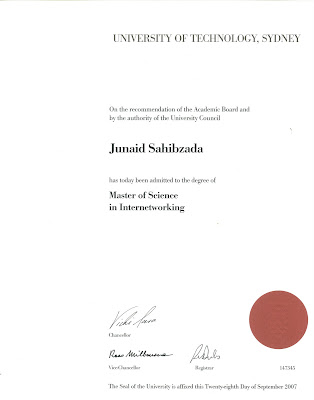
Degree awarded during graduation ceremony


Permanent Residency

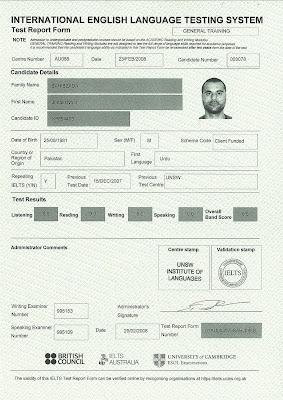
I applied for Permanent residency on the 27th of Sept, 2007. After appearing in the IELTS exam for three times, I was able to achieve a score of

Listening 8.5
Reading 9.0
Writing 8.0
Speaking 9.0

in the exam because of which I was able to claim the extra bonus points.


Copy of my IELTS report.

Finally on the 28th of May, after waiting for almost eight months , I was awarded the permanent residency.


Stamp of permanent residency on my passport.

End of story!

Thursday, May 22, 2008

Australia updates Migration Occupations in Demand List

Australia has updated its Migration Occupations in Demand List (MODL), adding twelve new specialties and removing one. The MODL is a list of occupations that the Department of Education, Employment and Workplace Relations (DEEWR) consider to have a shortage of skilled labor in Australia.

Immigration authorities grant bonus points to skilled migrants who have experience in an occupation listed on the MODL when applying for skilled immigration to Australia. The nation uses a points based system, much like the UK's Tier 1 skilled immigration system, which assesses applicants based upon factors such as age and past experience. Successful applicants may be eligible to immigrate to Australia under a permanent visa, even without a previous job offer from an Australian employer.
Twelve occupations were added to the MODL on 17 May 2008, including five Computing Professional specializations. Electronics Engineer, Optometrist and Dental Technician were also added to the list. In addition, three trade occupations were added: Binder and Finisher, Landscape Gardener, and Tree Surgeon.

The 'Computing Professional specializing in Sybase SQL Server' profession was removed from the MODL.

For a complete listing of occupations in demand in Australia, see our online MODL. Also, please note that the MODL is a separate list from the Skilled Occupation List (SOL).

People applying for skilled immigration to Australia under the General Skilled Migration program must show experience and/or qualifications in a job listed on the SOL to qualify for entry. However, if they can also nominate an occupation that is also listed on the MODL at the time the application is lodged or assessed by immigration authorities, they can gain bonus points for the 'occupation in demand/job offer' section of the General Skilled Migration points test.

To see if you have the qualifications that Australia is looking for, use our points calculator.

Thursday, March 20, 2008

A-Z of Offshore Migration

In my previous posts, I have mainly discussed onshore migration visas. You can find related posts for onshore migration here, here and here.

Just to recap once again, following are the different categories for offshore migration visas.


Offshore immigration. If you are outside Australia

Skilled – Independent (Migrant) visa (subclass 175)
A permanent visa for people with skills in demand in the Australian labour market. Applicants are not sponsored and must pass a points test.

Skilled – Sponsored (Migrant) visa (subclass 176)
A permanent visa for people unable to meet the Skilled – Independent pass mark. Applicants must be either sponsored by an eligible relative living in Australia or nominated by a participating State or Territory government. Applicants must pass a points test lower than that for the Skilled – Independent visa.

Skilled – Regional Sponsored (Provisional) visa (subclass 475)
A three (3) year provisional visa for people who can meet the lower pass mark for this visa. Applicants must be either sponsored by an eligible relative living in a designated area of Australia or nominated by a participating state/territory government. After living for two (2) years and working for at least one (1) year in a Specified Regional Area, applicants can apply for a permanent visa.

Skilled – Recognised Graduate (Temporary) visa (subclass 476)

An 18 month temporary visa for graduates of recognised overseas educational institutions who have skills in demand in Australia. There is no points test for this visa.

There are some other offshore migration visa options but all of them come with strings attached. Which means there are conditions attached to them.

Obviously, every one would be interested in the visa subclass 175 which doesnt place any restrictions of any sort. You can live and work any where in Australia. The rest of the visas have their conditions like living in a particular area etc.


How to Apply for offshore migration

Step 1.


The first step in applying for an offshore migration visa subclass 175 is to chose a profession which is listed on the Skilled Occupation List, SOL, or the Most on Demand List, MODL.

If your profession is not listed on the SOL/MODL then you cannot apply for skilled migration. There might be other ways but this post only deals with skilled migration.

Also, you must satsify some basic criterias for being able to apply for offshore skilled migration. For example, you should be under 45 years of age AND you must have post-secondary (such as university or trade) qualifications (in a small number of occupations substantial relevant work experience may be acceptable) and your skills must have been assessed by the relevant Australian assessing authority as suitable for your nominated occupation.


Check what the is current pass mark for your visa sub class 175. And see that provided you get a positive skills


Step 2.

The second step is to make sure that you have, in the past 24 months before you lodge the application, at least have 12 months of experience in the profession you have selected on the SOL/MODL.

Please note that this is only the immigration departments work experience requirement. You might need more work experience depending upon who your assessing body is.

For example for IT professionals the work experience requirement set by the Australian Computer Society, ACS, is 4 years, whereas the work experience requirement set by Engineers Australia for engineers is zero years. Yes, engineers Australia require an engineer to write a competency demonstration report. If you write a good report perfectly, you get a positive skills assessment. If you write an unsatisfactory report, you get a negative skills assessment. So basically you can get yourself assessed from engineers Australia right after your undergrad degree and then work for one year and then apply for immigration.

In order to get a positive skills assessment from ACS, an IT professional must have 4 years of work experience. If you do not have 4 years of work experience, ACS will not give you a positive skills assessment. Which means the Immigration department will not be able to consider you for immigration as the ACS doesn't consider you a qualified IT professional.


Step 3

Get yourself assessed by your assessing body. The name of each assessing body is listed next to the profession on the SOL/MODL.

Different assessing bodies have different criterias for giving overseas applicants a positive skills assessment.

For example, an IT professional, must have studied in a degree which has 75% of core computer science subjects AND also have 4 years of paid professional experience in the IT industry.

For engineers, the Australian Engineering council requires writing of a Competency demonstration report, CDR, by the candidate as well as 3 years of professional experience.

Most assessing bodies consider undergraduate degrees PLUS work experience as the criteria for giving a positive skills assessment to a candidate.

The process of getting a positive skills assessment takes any where between 8 to 12 weeks.


Step 4

Appear in the IELTS exam. You must be at least at the "competent" level in the IELTS exam to be eligible to apply for occupations other than trade occupations. You should have a high enough level of English that would enable you to score at least a "6" on all four components of the IELTS (International English Language Testing System) examination. However, if your nominated occupations is a trade occupation, a score of "5" (vocational) will suffice.

From Sept 1, 2007, any one getting 7 and above in all bands of IELTS is awarded bonus points and an applicant can gain 25 points if he/she scores 7 or above in all bands of IELTS in either academic or general version of the test.

Step 5

After having acheived a positive skills assessment and a score in IELTS exam, you should lodge an application with the Department of Immigration and Citizenship, DIAC.

While applying online, you will realize how many points you are scoring. It is better to calculate your points beforehand using the points calculator which you can access at the following link.

Points calculator

If you are falling short of points, it would be advisable to contact a lawyer.

It is better to lodge the application online as that speeds up the process.

The online process is pretty straight forward. Once the application is lodged online, you might be asked to send original documents by post.

The process takes between 10 to 16 months.


Bonus Points

You can gain bonus points for getting 7 and above in all bands of IELTS, for having a spouse whose profession is also on the SOL/MODL. Note that to claim points for spouse skills, the spouse will also have to proove his/her skills by getting a positive skills assessment from the relevant assessing body.