Google Search

Google
 

Sunday, July 13, 2008

Australia responds to need for skilled migrants

Three new Australian 'Centres of Excellence' have been set up in Perth, Sydney, and Melbourne to speed up the processing of temporary 457 visa applications for employers wishing to hire overseas workers.

The centers were set up in response to increasing demand by Australian employers for skilled workers from overseas to help ease labor shortages.

The 457 visa allows Austrlalian employers to employ skilled workers from abroad to fill occupations in Australia on a temporary basis for between three months and four years.

The centers come in response to recommendations by a panel of experts commissioned by the government to help improve the efficiency of the 457 visa program.

According to Immigration Minister Chris Evans, 457 visa processing times were already showing improvement.

"In June 2007, an average of 400 cases was processed within seven days whereas in June 2008, more than 1200 applicants were granted visas within a week," Evans said.

"The 457 program is critical to meeting the current labour market demands and the new Centres of Excellence will continue to improve the effectiveness of the processing of visas," he added.

Australian immigration authorities were dealing with a backlog of about 13,000 subclass 457 visa applications since March. That backlog has since been cleared.

The 457 visa is only one of many visas designed to bring skilled overseas workers to Australia. The General Skilled Migration (GSM) program allows skilled individuals in a long list of occupations to immigrate to Australia permanently, with or without an existing job offer with an Australian employer.

Monday, June 23, 2008

Australia: Mining industry looks to immigration for skilled workers

A new report commissioned by the Minerals Council of Australia states that the Australian mining industry will need an additional 90,000 workers by 2020 to keep up with demand in the growing industry. The report said that increasing skilled migration is one step towards achieving this goal.

The report forecasted a 6 percent annual employment growth rate to 2012, double the Australian government's estimate of 3 percent and "far higher" than previous industry forecasts.


Due to the minerals and energy requirements of India and China, Australia is expected to make it through largely unaffected the recent uncertainty in global financial markets resulting from the slump in the United States housing market.

"We are confident we are three years into a 'super cycle' of global demand for our products - a decade and more of sustained demand - which some consider could even last twenty years," said Minerals Council Chief Executive Mitchell H. Hooke.

"The report found that more than half the growth in jobs will occur in Western Australia, Queensland's minerals industry labour force will grow by 50 percent and South Australia's demand for minerals workers will more than double", Hooke added.

Skilled migration is seen as an important source of employees for the mining industry. Mining professions, among many other occupations, are listed on Australia's Skilled Occupation List, for which the government grants permanent visas under its General Skilled Migration program.

"While the Minerals Council welcomes recent Federal Government initiatives to increase the number of skilled training places and streamline temporary visa applications for skilled immigration, more must be done to[...]further increase skilled migration," Hooke said.

However, the Australian government has not been sitting idly by while Australian employers clamor for more skilled immigrants. Recently, the Australian government increased the number of skilled migration places for the current year, increasing the quota from 102.500 to 133,500 for 2008-09.
Source: Work Permit

Sunday, June 8, 2008

My story

Achieving the Permanent residency status is the number one agenda of every international student or prospective migrants wanting to come to Australia.

I was one such international student who arrived in Australia on the 2nd of Feb, 2005 and became a permanent resident on the 28th of May 2008. I had to go through a painful, stressful and outrageously expensive process , though, I think there was also a less expensive way to do so.

Any how, what is done is done. Let me narrate my story in pictures and words. Hope the readers are able to make a much better decision and learn from my experiences.


Offer of admission from UTS

I was offered a letter of offer from UTS some where in Nov 2004. I quickly started the procedure for the final grant of a student visa to Australia. Paying the tuition fees, performing medical check ups, blah blah.

Grant of visa


Finally after filling out all the forms, submitting all the documents requested, I was finally granted the visa.


Letter of grant of visa from the Australian High Commission, Islamabad, Pakistan


Unlike previous times, I was not interviewed for the visa. The visa was sent stamped on my passport and sent to the offices of my educational consultant.


Original Student visa as stamped on my passport. The label has been stamped inoperable on expiry.

Studying at UTS

Studying while searching for work and getting blue collar jobs such as filling shelves in super markets, washing cars and delivering pizzas was some thing I had never done before.

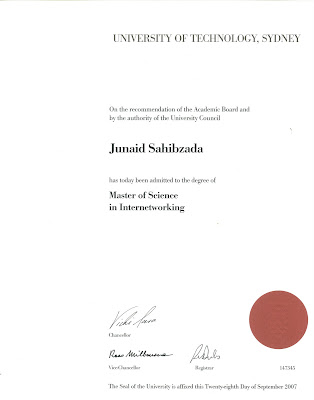
After a lot of struggle, hard work, patience and determination, I was finally able to finish my studies from UTS


Page one of my UTS transcript


Degree awarded during graduation ceremony


Permanent Residency

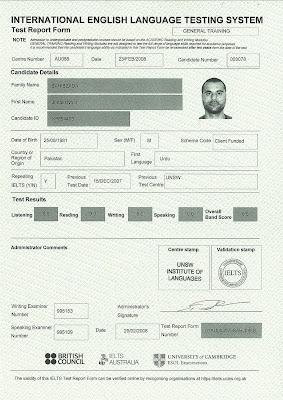
I applied for Permanent residency on the 27th of Sept, 2007. After appearing in the IELTS exam for three times, I was able to achieve a score of

Listening 8.5
Reading 9.0
Writing 8.0
Speaking 9.0

in the exam because of which I was able to claim the extra bonus points.


Copy of my IELTS report.

Finally on the 28th of May, after waiting for almost eight months , I was awarded the permanent residency.


Stamp of permanent residency on my passport.

End of story!